SAM HUNTER
ART HISTORIAN, 1923 - 2014
Sam Hunter was a 20th century Art Historian, Author, Museum Director, Curator, Art Critic and Professor of Art History. He taught in the Department of Art and Archaeology at Princeton University in Princeton, New Jersey, USA. Sam was born in Springfield, Massachusetts, attended Williams College and served in the Pacific in the United States Navy during World War II.
He began his career as an art critic at The New York Times in 1947 while studying painting with Hans Hofmann at his School of Fine Arts in New York City, NY. Sam met many artists and writers in the late 1940's several of whom became lifelong friends and colleagues.
The young art critic left the New York Times to take advantage of his Hubbard Hutchinson fellowship from Williams College to study art history in Europe for three years. He studied with Roberto Longhi and Bernard Berenson in Florence at I Tatti, earned a certificate from the University of Florence, spent a year at the American Academy in Rome and learned to speak Italian. He traveled widely in Europe, was a stringer for LIFE magazine in Egypt and began to work with the artists Francis Bacon and Arnaldo Pomodoro.
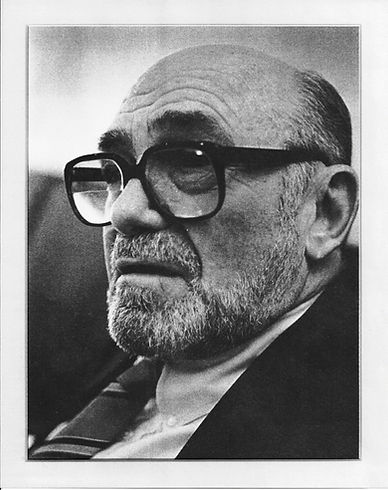
Sam Hunter, photo by Kurt Blum
An Associate Curatorship at New York's Museum of Modern Art and the position of Acting Director of the Minneapolis Institute of Arts prepared him to don the mantle of Founding Director of the Rose Art Museum at Brandeis University. While at MoMA he mounted the first major Jackson Pollock exhibition at a museum. With reputation cemented via his noteworthy educational and collecting program at The Rose and his role in the controversial 1964 Venice Biennale as champion of Robert Rauschenberg, he joined the Jewish Museum. As its Director he carried the torch of the avant garde in full flame.
Professor Hunter created remarkable modern and contemporary syllabi and coursework for his Princeton University students, the Clark Art Institute, UCLA, Harvard University and other institutions of learning. He curated exhibitions, organized symposia, panel discussions and conferences and conducted unique consistent research solo and in engagement with his students on exhibition and publication projects. He served as advisor and consultant to museums, government agencies, art galleries, corporations and art collectors. Among his public roles was that of advisor on the Tilted Arc Committee in 1988 - 89, formed to help determine the fate of the contentious placement of a Richard Serra sculpture which almost entirely traversed a public plaza in downtown Manhattan. His single articles, book reviews, commentary, essays and syndicated art columns were published in newspapers and magazines internationally, and he appeared on local, national and international television shows as an expert on artists and movements. Currently he is frequently quoted in art world related goings on, classrooms, lectures and various publications.
Sam Hunter was a prolific writer, exhibition organizer and curator and his written output was prodigious. Because he was one of the few who were intimate with the center of an art world from the 1940s through 2009 that was smaller than ours today, paired with his unusual ability to assemble, shape and direct ideas, he was uniquely situated to write and produce enlightened monographs on artists, textbooks on art history, articles, and exhibition catalogues, singly and in collaboration with other art historians over the duration of his long and productive career. It is this body of his industry that will stand as his special brand of fundamental contribution to the library of art historical knowledge and its study.
He organized a legion of exhibitions in the United States, Europe, South America, and Japan, working with modern and contemporary art and artists and wrote or contributed to many of the associated exhibition catalogues. The scope of Professor Hunter's instruction is global - in part because of the vast distribution of his written works in universities, among art lovers and art world natives over a prolonged period of time. Former students throughout the working art world and in the general public have further spread and extended his influence. Sam was a rock-star of the intellectual sphere of his time.
Sam was one of the pioneers of what was for the most part uncharted territory in the field of art history in the mid to late twentieth century. The impact of Sam Hunter's standard bearing and energetic writing, teaching, curatorial activities and legacy as a whole have directly contributed to the evolution of our ideas about our relationship with art and art history and their place in contemporary, personal, community and global life.
His work will forever color our experience of art and has supported its integration with our daily lives as a valued and necessary element of culture. We can use his voice as a guidepost to aid us in navigating our transformation into a visually oriented media based culture that is richly populated with signs and symbols. And, we can be thankful that he left a trail of prodigious creation in his wake - he was a veritable fountain of energy, inspiration and ideas that we will most certainly be drinking from for countless years to come.
- M. Hunter
